My Lock Screen Became a Good-Luck Charm: One Semester of Testing an AI Omamori
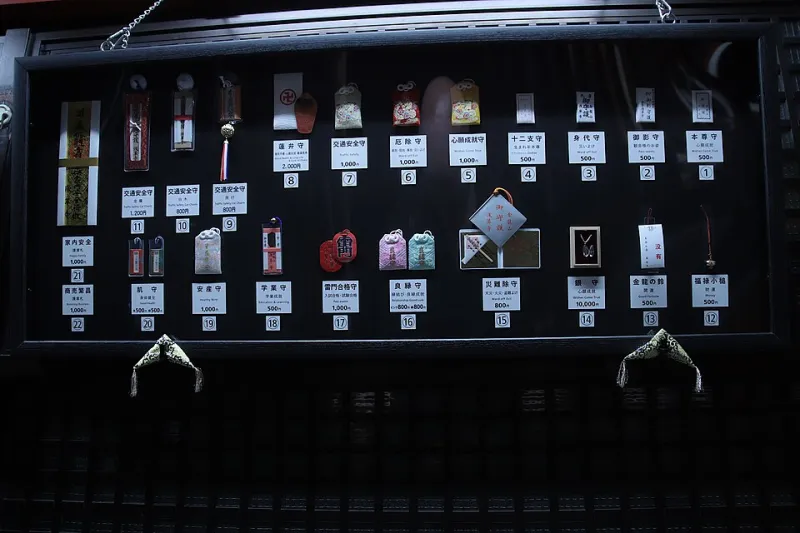
Photo: Cedric007, CC BY-SA 4.0, via Wikimedia Commons
Every spring outside Tokyo's Yushima Tenmangū shrine, students in uniform line up to buy small brocade pouches called omamori — literally "protection" — dedicated to the god of learning. You don't open them. You don't check what's inside. You just carry one, and somehow the act of carrying it makes the MCAT feel a little less like a cliff.
I've never owned an omamori. But I've owned a phone for fifteen years, and my phone has never once wished me luck before a practice test. So this semester, I decided to close that gap: I'd build myself a digital omamori — an AI ritual that lived on my lock screen — and see if a superstition made of software could do what brocade and stitching have done for Japanese test-takers for centuries.
What a Charm Actually Does (According to My Psychology Professor Friend)
Before the experiment, I wanted to know if there was anything under the hood. My friend Dana, a psych grad student, lit up at the question.
"That's just a placebo with good branding," she said, "but placebos work even when people know they're placebos. There's research on this. Rituals before performance tasks — even meaningless ones — reliably lower anxiety and slightly improve outcomes."
That was the whole thesis. The charm doesn't pass the test. The charm calms the person who has to pass the test. And anxiety, unlike calculus, is very responsive to a ten-second ritual.
Building the Digital Charm
I wanted three things from my AI omamori: a visual anchor, a daily pep talk, and a small ritual I'd actually perform. Here's the setup, in case you want to steal it:
The lock screen image. I generated a simple design — a red-and-gold pouch, the traditional omamori colors, with the word "合格" (gōkaku, "pass") stitched across it. It's the same word our site is named after, and honestly, having "PASS" staring at you every time you check the time does something to your brain. I set it as my wallpaper with the photo shuffled off, so it never changed.
The morning message. Using a scheduled reminder and a saved chatbot prompt, I set up a daily message that blended encouragement with a wink of superstition. Sample from March 4th: "The charm is in your pocket. The formulas are in your head. Today you review chapter 9 and trust the process. Do not open the charm. Do not skip chapter 9."
The pre-study ritual. This was the part I was most skeptical about. Before every study session, I'd tap a shortcut that opened a chatbot conversation with a fixed prompt: "I'm starting a study session. Give me one sentence of encouragement and one sentence of what I'm walking away with today." Then I'd put the phone face-down and start.
Total setup time: about forty minutes on a Sunday afternoon. Total cost: zero dollars.
Week 3: The Eye-Roll Phase
Full disclosure — the first few weeks felt silly. The pep talks were generic in that AI way, all exclamation points and "You've got this!" energy. I almost quit.
What saved it was tightening the prompt. I told the chatbot to be more like a dry, slightly superstitious grandmother than a pep squad. Suddenly the messages had personality: "You reviewed flashcards yesterday. The ancestors noticed. Do it again." It sounds ridiculous written down. It was, somehow, exactly the tone that made me want to open my notes.
What Actually Changed
I kept a simple log all semester: anxiety before each study session (1–10), minutes studied, and whether I showed up at all.
The results weren't magic, but they weren't nothing:
- Showing up: My skipped-session rate dropped from about three per week to one. The ritual created a threshold — once I'd done the tap, the little bow to the lock screen, starting felt easier than skipping.
- Anxiety before exams: My pre-test ratings dropped from an average of 7.5 to about 5. I can't prove the charm did it, but the ritual of touching the phone, seeing the pouch, and reading one line gave my spiraling brain somewhere to land.
- Grades: One midterm went up meaningfully, one stayed flat. Which is to say: the charm did not take the test for me. The 40 extra study sessions probably did.
The Part That Surprised Me
Somewhere around week eight, I realized the charm's real function wasn't luck — it was separation. Every session had a tiny beginning and the chatbot gave it a tiny ending ("Session logged. Close the books. The charm holds your progress."). That structure bled into how I studied. I stopped treating studying as an amorphous dread-cloud and started treating it as a series of small, bounded appointments.
Japanese students return their omamori to the shrine after the exam, thanking it before buying a new one. I liked that so much I copied it: after my final, I had the chatbot write a short "retirement note," then archived the whole thread. It's still in a folder called "shrine."
Want to Make Your Own?
You don't need to care about Japanese shrines for this to work. The recipe is universal:
- Pick a visual anchor — an image, emoji, or wallpaper that means "test season" to you.
- Write one ritual — a fixed prompt, a daily message, a ten-second action before you study.
- Give it a personality — generic encouragement dies fast; a voice with character survives the semester.
- End it deliberately. When the exam is done, close the loop. Rituals need endings to feel real.
Did my digital omamori improve my focus? The data says maybe. The superstition says definitely. And honestly, after a semester of carrying a little embroidered "PASS" on my lock screen, I've stopped caring which one is true.