Snatch the Card, Ace the Test: How to Turn Any Vocab List Into an AI-Generated Karuta Battle
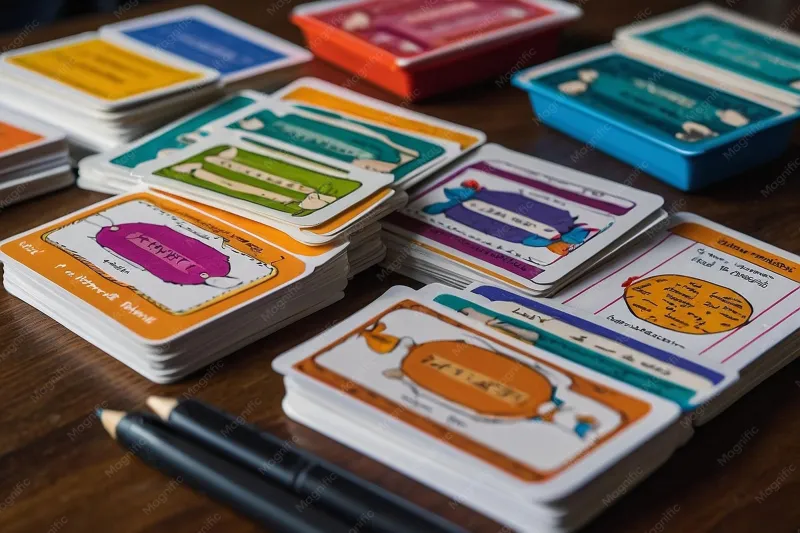
Photo: colorful flashcards spread on table study game, via img.freepik.com
Every Japanese kid grows up playing karuta on New Year's Day. The setup is simple and slightly chaotic: cards spread face-up across a tatami mat, a reader calls out a prompt, and everyone lunges to grab the matching card before their cousins do. It looks like a family squabble. It's actually speed-recall training disguised as fun — and it's exactly the kind of active retrieval that memory researchers keep begging us to do more of.
Here's the good news: you don't need a tatami mat, a deck shipped from Kyoto, or even a study partner who owns pants. With an AI chatbot and about ten minutes, you can turn any exam's vocab list into a playable karuta-style game. I've been doing this for three weeks with an anatomy course, and it's the first time memorization has felt like something other than homework.
Why Grabbing Beats Rereading
Passive review — highlighting, rereading notes, nodding at flashcards — creates what psychologists call the illusion of fluency. The material looks familiar, so your brain files it under "known," even when it isn't.
Karuta-style games fix this by stacking three proven techniques on top of each other:
- Active recall: you must produce the match from memory, not recognize it
- Time pressure: the countdown forces fast, automatic retrieval — the same speed you need during a timed exam
- Competition: even against a timer or a friend over video chat, the stakes make your brain treat the info as worth keeping
This is why it works so well for memorization-heavy subjects: AP Bio terms, med school anatomy, pharmacology drug classes, SAT vocab, art history movements. Anything where the exam asks "what is this called?" is karuta territory.
Step 1: Feed the AI Your Terms
Open any capable chatbot — ChatGPT, Claude, Gemini, whatever you already use — and paste in your term list. A spreadsheet export, your flashcard deck, or just typed-out notes all work. Then use a prompt like this:
"I'm studying for [exam name]. Here are my key terms and definitions: [paste list]. Turn these into a karuta-style matching game. Create a 'call card' (the prompt read aloud) and a 'grab card' (the matching answer) for each term. Make the call cards tricky but fair — use descriptions, examples, or context clues instead of just repeating the definition. Format everything as a table."
That last instruction matters. If the call card is just the definition verbatim, you're doing matching, not thinking. Ask the AI to paraphrase, use real-world examples, or describe the term's function. For anatomy, for example: instead of "the definition of the femur," you get "the longest bone in the human body, and the one that breaks in most ski accidents."
Step 2: Pick Your Way to Play
You've got three solid free options, depending on how much effort you feel like spending:
The no-tools version (2 minutes): Have the AI number each grab card. Read a call card aloud (or have it read them one at a time), give yourself five seconds, then name the matching term before checking. Solo, zero setup, works on your phone.
The printable version: Ask the AI to format the grab cards as a 4x4 or 5x5 grid, print them, cut them out, and spread them on a table. If you have a roommate or study group, this is the real deal — first hand on the card wins it. Loser refills the coffee.
The digital version: Paste your card pairs into a free flashcard platform with a matching or game mode — Quizlet's Match mode is the closest thing to solo karuta that exists, and Flippity (a free Google Sheets template site) has a dedicated game-show style matching board. Ask the AI to output your cards as a CSV and import directly.
Step 3: Add the Difficulty Dial
Here's where the AI genuinely outperforms a store-bought deck. Ask it to generate multiple rounds at different difficulty levels:
- Round 1 — Warm-up: straightforward call cards, generous time limit
- Round 2 — Sabotage: the AI includes "decoy cards" — near-miss terms that sound similar (mitosis vs. meiosis, tendons vs. ligaments) and are laid out alongside the real ones
- Round 3 — Reverse mode: the grab cards become the prompts, so you're recalling in the opposite direction
That decoy round is the killer feature. Exams love to put two similar-sounding terms in the same question, and karuta with decoys trains you to distinguish them under pressure — which is basically the whole game on test day.
My Three-Week Verdict
I ran this with a 90-term anatomy unit. Two 15-minute karuta sessions beat three 45-minute rereading sessions, at least by the only metric that mattered: my practice quiz scores jumped from the low 70s to high 80s, and the terms I'd grabbed in games were the ones that came back to me instantly.
There's also something the scores don't capture: I wanted to play. Nobody has ever described rereading a textbook that way.
If your next exam is a vocabulary arms race — bio, anatomy, psych, a foreign language — skip the highlighter. Paste your list, generate your deck, and start snatching. Your future self, hovering over the right answer while the clock ticks, will thank you.